Pops
The Dog StarsPops is Cima’s father, a seasoned rancher and former Navy SEAL whose competence shapes both his family’s escape from the collapsing world and their later survival alongside Hig and Bangley. He is defined by a tension between fierce attachment to inherited land and the clear-eyed readiness to leave it when remaining becomes impossible. His arc turns the canyon from a refuge into a home he must surrender, then brings him into a new, tactical partnership at the airfield.
Identity and Introduction
Pops first appears as an armed old man outside a house in the canyon, raising his gun toward Hig’s plane. He fires birdshot into the aircraft, tearing the aluminum and shattering the left window; the impact also burns and stings Hig’s face. The scene introduces Pops through immediate danger: from the air, he is an unknown threat guarding his ground, and the gunfire makes clear that an unexpected arrival will not be welcomed without suspicion.
That first impression is complicated when Hig comes into conflict with him on the ground. After Hig says he has lost Jasper and challenges Pops to shoot him, Cima intervenes, telling her father to let Hig up. Pops releases the rope. His willingness to stop at his daughter’s insistence reveals a relationship in which Cima can confront his authority, even in a tense encounter. Hig then walks away to the creek and sobs alone; the moment follows the loss of Jasper and exposes the grief beneath his defiance.
Ranch, Lineage, and the Decision to Leave
Pops’s attachment to the canyon is not merely practical. He tells Hig that the ranch belonged to his grandfather, who ran cattle there before the Bureau of Land Management existed to lease grazing land. Hig recognizes that the destruction of the grazing country seems to wound Pops more deeply than the death of the human race. That observation shifts Hig’s understanding of him: the ranch is not just a defensible refuge, but the inheritance of a family and a way of life.
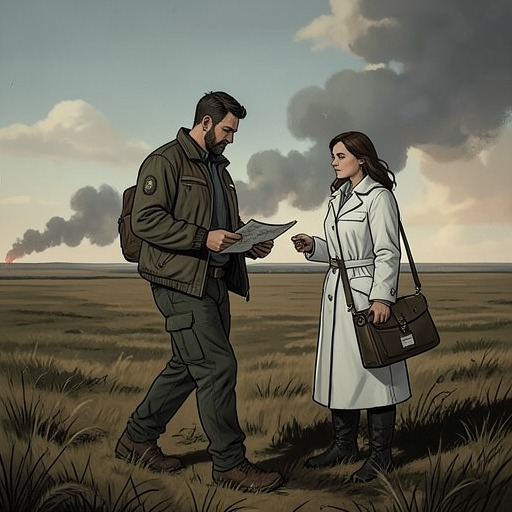
The family had already made one dangerous move to reach the canyon. As the pandemic worsened, Pops and Cima loaded a gooseneck cattle trailer and a smaller trailer for the four-wheeler, taking cattle, sheep, two saddled horses, two Australian shepherds, and provisions. Pops expected violence on the road and fought through three barricaded ambushes in the fifteen miles to the creek road, then shot three attackers in the cedar hills. The raiders killed one horse and two sheep inside the trailer, making it harder to pass as though the family were simply driving cattle to a summer lease. Pops rode horseback while Cima drove the ATV and trailer; he was experienced at herding livestock in the saddle, and the dogs followed his commands. The next morning, he used dynamite to destroy the only ford across the creek, leaving passage possible only on foot or horseback and then only at low water.
Even after making the canyon defensible, Pops eventually agrees to leave it. When Hig says that he will fly Pops, Cima, and himself out, he asks why they would abandon their small Eden, where the remaining family can live in peace. His resistance is grounded in what the place means, not simply in a refusal to face the outside world. Yet the prospect of departure gathers momentum. After Cima’s bruises require three more nights of waiting, the mood improves and the group begins to prepare to go.
Departure and the Airfield
Pops leaves before full light, without ceremony or farewell. He looks once at the canyon and its remaining Cattle and Sheep, takes a light pack and his rifle, then walks downstream through the brush fence. He latches the gate behind him. The plainness of the gesture gives weight to the loss: he is leaving not only a refuge but the land of his own lineage, the life to which his parents and grandparents had belonged. His departure is an act of survival that cannot be mistaken for indifference.
At the airfield, Pops’s alertness and tactical instincts remain intact. When Hig circles back with Bangley aboard and sees Pops near the runway, Pops has moved a lamb and raised his gun to scan the hangars and wreckage. A taut cable stretches across the runway, held ten feet above the pavement by sprung steel arms; its dark line is difficult to distinguish from the tarmac. The danger is not just the ambush but the fact that Pops is standing within its field, armed and watchful. Hig recognizes him and the cable before landing, with only two gallons of fuel remaining.
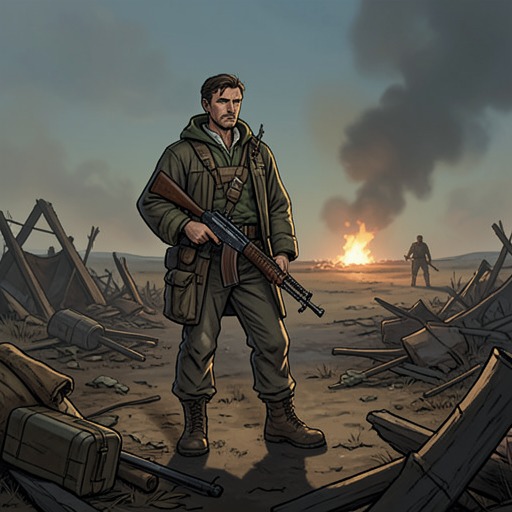
Once on the ground, Pops and Hig advance carefully toward the tower and the adjacent fixed-base-operator offices. Hig takes his AR-15, switches on the handheld radio, and retrieves the grenades from beneath one of the lambs. Pops leads around the south corner of the building, keeping close to the wall and out of sight; before crossing the open ramp, the two men stop to assess the exposed route to the brick office building and its rear door. Pops’s conduct here makes their cooperation visible in action: he is not merely being evacuated but helping Hig confront the danger at the airfield.
New Alliance and Continuing Character
After the danger at the airfield, Pops takes a house beside Bangley’s and chooses an upstairs room overlooking the field, a position suited to someone who remains a tactician. He sandbags its one window. When Bangley has recovered enough to sit up, Pops introduces himself and deferentially asks to borrow Bangley’s Sig Sauer rifle. Their first exchange is spare, but Pops’s half grin and his respectful touch on Bangley’s bandaged forearm establish an unexpected affinity between the two older men. Hig sees them as alike in the way they almost smile.
Bangley asks Pops about his past, and Pops answers that he served with the Navy SEALs in Afghanistan and elsewhere. The disclosure clarifies the experience behind his composure and tactical habits, while leaving the focus on how little explanation he needs to give. The former rancher who guarded his canyon, anticipated ambushes on the road, and watched the airfield from above now has a place beside Bangley. Pops’s movement from inherited land to a defended house near the runway does not erase what he lost; it shows how the skills and vigilance formed by his earlier life become the means of making another one possible.